
Magnetoelectric 3D printing technology
The revolution of actuatable composites


news


EVA Final Stakeholder Meeting: Connecting Innovation with Real-World Needs
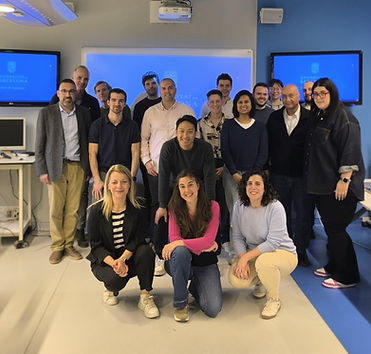
On 25 September 2026, the EVA consortium hosted its Final Stakeholder Meeting, bringing together project partners, external experts and stakeholders to discuss EVA’s technological developments and their potential applications.
The meeting created a multidisciplinary forum connecting EVA’s work on advanced responsive materials and wireless actuation with perspectives from potential application fields, particularly rehabilitation and spinal cord injury (SCI).
Invited experts shared insights into priorities for recovery in SCI, current and emerging rehabilitation technologies, and their clinical relevance, providing an important end-user perspective on the development of innovative technologies. The programme also addressed electromagnetic-field exposure and safety considerations, an important aspect when considering the potential translation of emerging technologies towards healthcare applications.
The discussions demonstrated the value of bringing together expertise from materials science, engineering, medicine and rehabilitation at an early stage when considering the future development and application of emerging technologies. They also provided the EVA consortium with valuable perspectives on clinical needs, technological opportunities and considerations relevant to future translation.
The Final Stakeholder Meeting represented an important opportunity for two-way exchange between technology developers and external experts, helping to place EVA’s research and technological achievements within a broader application-oriented context.
We warmly thank all invited speakers, stakeholders and consortium members who participated in the meeting and contributed their expertise and perspectives to the discussion.
From Research Results to Exploitation: EVA Workshop Explores Pathways to Impact
As the EVA project approaches its conclusion, attention is increasingly turning towards how the knowledge and technologies developed within the project can continue to create value beyond its lifetime.
On 21 September 2026, the EVA consortium participated in the online workshop “Economic Exploitation of Research Results: Exploring Pathways through Real Cases – The Options, the Process, the Challenges,” led by a Technology Transfer and Innovation advisor.
The workshop focused on the practical transition from research results to exploitable assets, using real cases to explore different routes through which research outcomes can move towards economic exploitation. The session examined four main pathways: industry collaboration and co-development, contract research and specialised services, intellectual property licensing, and spin-off creation.
Beyond presenting the available options, the discussion addressed the processes and challenges involved in selecting an appropriate exploitation pathway and highlighted how factors such as technological maturity, intellectual property, available expertise and market needs can influence this decision.
The workshop provided the EVA consortium with an opportunity to consider the future of project-generated knowledge and technologies beyond the funded project period and reinforced the importance of integrating exploitation thinking into the research and innovation process.

EVA Technology: From Smart Materials to Meaningful Solutions
EVA is developing a new generation of wirelessly responsive 3D-printed composites by bringing together magnetic materials and advanced 3D-printing technologies.
By integrating magnetic functionality into complex 3D structures, EVA explores materials whose shape, movement and function can be controlled remotely through external magnetic fields. This approach opens new possibilities for innovative applications across areas such as biomedicine, robotics and advanced functional materials.


EVA Stakeholder Meeting: From Innovation to Impact
On 25 September 2026, the EVA project will hold an online stakeholder meeting focused on bridging technology, healthcare and society.
The meeting will bring together experts from research, clinical practice, regulation and industry to discuss the transition of innovative materials and magnetic technologies towards real-world healthcare applications. The programme will cover the EVA vision, safety and regulatory considerations for magnetic technologies in clinical environments, priorities and technological advances in spinal cord injury rehabilitation, and the translation of magnetic microrobots from research to clinical application.
As EVA approaches its completion, the meeting will provide an important opportunity to consider how the project’s technologies and research results can contribute to healthcare innovation and create value beyond the project’s lifetime.
Date: 25 September 2026
Time: 13:00–15:00 CET
Format: Online
EVA Workshop on the Exploitation of Research Results
As the EVA project approaches its completion, the consortium will participate in an online workshop on the economic exploitation of research results on 21 September 2026.
With a Technology Transfer Consultant and Lawyer, as key speaker, the workshop will explore how research outputs can develop into exploitable assets through pathways such as industry collaboration, specialised services, IP licensing and research-based spin-offs.


EVA Research Presented at Fields4CAT Academic Event in London
Dr. Semih Sevim presents EVA-related research on electrostatic catalysis at King’s College London
EVA researcher Dr. Semih Sevim from ETH Zürich participated as an invited speaker at the Force Fields in Redox Enzymatic Catalysis – Fields4CAT academic event, held from 19 to 21 May 2026 in London, UK.
During his invited talk, entitled “Electrostatic Catalysis in Microfluidic Cell,” Dr. Sevim presented research exploring how electric fields can be used to drive chemical reactions within a microfluidic platform. The work demonstrates a continuous-flow microfluidic reactor in which electrostatic catalysis can be implemented under controlled mass-transport conditions, offering a route towards clean and metal-free catalytic processes.
The research presented at the event was published in Nature Communications in the article “Electrostatic catalysis of a click reaction in a microfluidic cell,” with Dr. Sevim as first author. The publication acknowledges support from the EVA project (GA No. 101047081) and brings together researchers from ETH Zürich, the University of Barcelona, King’s College London and other institutions.
The Fields4CAT event provided an opportunity to present these findings to an academic audience working on electric fields, enzymatic catalysis and related approaches to controlling chemical reactions, while further disseminating research connected to EVA beyond the project Consortium. The Fields4CAT initiative itself investigates the forces governing redox enzymatic catalysis and includes work with ETH Zürich translating electrostatic-catalysis concepts into technological platforms.
Read the EVA-related publications here: https://zenodo.org/records/10717478
Collaboration and coordination across the EVA consortium
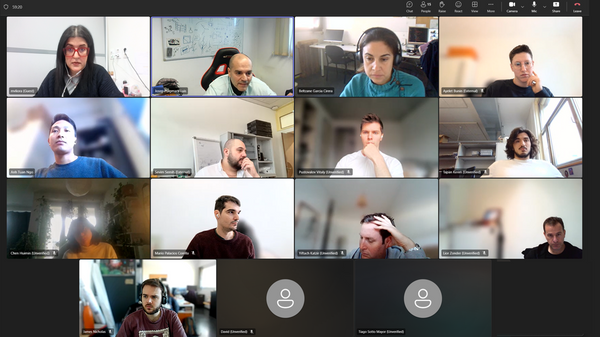
During a recent online consortium meeting, EVA partners came together to share updates, discuss ongoing activities, and coordinate the next steps across the different research teams.
The meeting included a presentation from colleagues at the Hebrew University of Jerusalem on their work related to DLP printing of non-modified gelatin-based composite objects, providing an opportunity to exchange insights, discuss progress, and connect this work with activities taking place across the wider project.
As EVA moves forward, these regular exchanges are essential for aligning expertise, strengthening collaboration between partners, and supporting the integration of the project’s different components into a shared technological direction.
Connecting teams, knowledge, and perspectives across institutions remains at the heart of EVA’s collaborative approach.

Attending FOAM@IBERIA 2025 to Advance Simulation Capabilities for EVA


On 11–12 September 2025, Dr. João Vale from Experian represented the EVA consortium at FOAM@IBERIA 2025, held in Coimbra and Figueira da Foz, Portugal. The annual conference focuses on OpenFOAM, an open-source computational fluid dynamics (CFD) platform widely used in research and industry.
Dr Vale's participation was directly linked to EVA’s work on developing and optimizing microfluidic nozzles for printing complex inks. The conference covered advanced workflows for modelling complex geometries, multiphase and non-Newtonian flows, and optimization-driven design — all highly relevant to EVA’s simulation framework.

Scientific sessions on viscoelastic flows and extrusion processes provided practical strategies for handling complex rheology and structuring optimization loops. Hands-on workshops on automatic extrusion die optimization and OpenFOAM programming further strengthened the tools available for improving simulation efficiency and extending solver capabilities.
The knowledge gained at FOAM@IBERIA 2025 supports more accurate modelling of ink behaviour and more efficient nozzle design within EVA, reinforcing the project’s commitment to integrating state-of-the-art computational methods into its research activities.

EVA: Creating Impact Across Disciplines
The EVA Project is more than a research initiative—it’s a vision for how cutting-edge science can serve society through innovation, collaboration, and sustainability.
By combining magnetic nanotechnology with advanced 3D printing, EVA aims to develop intelligent materials capable of adapting, responding, and performing in ways that traditional materials cannot.
At its heart, EVA brings together expertise from materials science, bioengineering, and environmental research to explore how magnetic nanocomposites can open new possibilities across multiple sectors.
These include biomedicine, where responsive materials can transform drug delivery and regenerative medicine, and environmental engineering, where magnetically retrievable systems can make water treatment cleaner and more sustainable.
But the project’s contribution goes beyond technical breakthroughs. EVA also seeks to model a responsible pathway for translating laboratory innovation into real-world value. By prioritizing sustainability, reusability, and lifecycle awareness, the project ensures that technological progress aligns with the broader goals of the European Green Deal and the Horizon Europe framework.
The collaborative spirit of EVA—linking scientists, industrial partners, policy makers, and the innovation ecosystem—ensures that the project’s results will not remain confined to the lab. Instead, they will fuel new opportunities for entrepreneurship, technology transfer, and cross-sector collaboration.
Ultimately, EVA’s work supports a future where smart materials contribute to both human wellbeing and environmental protection. By bridging disciplines and sectors, EVA stands as an example of how European research can create lasting impact—scientifically, economically, and socially.
EVA at the Baltic Conference Series in Stockholm
EVA Project Coordinator Prof. Josep Puigmartí-Luis from the University of Barcelona participated in the Baltic Conference Series, held from 13 to 15 October 2025 in Stockholm, Sweden, where he delivered an Advanced Materials Award Lecture.
His lecture, entitled “How Can Microfluidic Tools Help during the Self-Assembly and Engineering of Supramolecular Systems and Crystals?”, presented his research on the use of microfluidic technologies to control self-assembly and enable the development of advanced material systems.
The event provided an opportunity to exchange knowledge with researchers working at the forefront of advanced materials, materials engineering and emerging fabrication technologies. Through his participation, Prof. Puigmartí-Luis also contributed to the international visibility of EVA, connecting the project's work on advanced functional materials and innovative manufacturing technologies with a wider scientific community.
His participation formed part of EVA's broader efforts to disseminate the project, engage with relevant research communities and foster connections that can support the future development and exploitation of its results.

EVA Innovators Workshop: From Research Result to Exploitable Asset
On 14 October, the EVA project will organise an online Innovators Workshop exclusively for members of the EVA Consortium, entitled “From Research Result to Exploitable Asset: Identifying Value and Communicating Innovation.”
Led by Dr. Maria Vliora from Discovery Foundation, the session will focus on Early-Career Researchers and SME representatives, exploring how research results can be identified as exploitable assets and effectively communicated to non-academic audiences and potential stakeholders.
Through practical examples, participants will explore how to recognise exploitation potential, define the value of research outcomes and consider pathways towards real-world application.
14 October 2025 | 13:00–15:00 CET | Online

EVA Project Video: Shaping the Future with Magnetic Nanocomposites
We are pleased to announce the release of the EVA Project video! This short film introduces our work on magnetic nanocomposites and how they can be harnessed for smart biomedical and environmental applications.
From material design to real-world impact, the video presents EVA’s vision, goals, and innovative approach to addressing key societal challenges.
EVA at the Technical University of Munich

EVA Project Coordinator Prof. Josep Puigmartí-Luis from the University of Barcelona visited the Technical University of Munich (TUM) from 8 to 10 October 2025, where he delivered an invited seminar hosted by Prof. Berna Özkale Edelmann.
During the seminar, entitled “Unlocking Materials Innovation with Microfluidic Technologies,” Prof. Puigmartí-Luis presented the potential of microfluidic approaches to support innovation in the development and engineering of advanced materials.
The visit provided an opportunity to exchange knowledge with researchers at TUM, discuss developments in the field and explore potential opportunities for future collaboration. The scientific topics addressed during the seminar are closely connected to the broader research landscape in which EVA operates, bringing together advanced materials, innovative fabrication approaches and technologies for the development of new functional systems.
Prof. Puigmartí-Luis's participation also contributed to the dissemination and international visibility of the EVA project, strengthening connections with relevant research communities and creating opportunities for scientific exchange beyond the EVA Consortium.
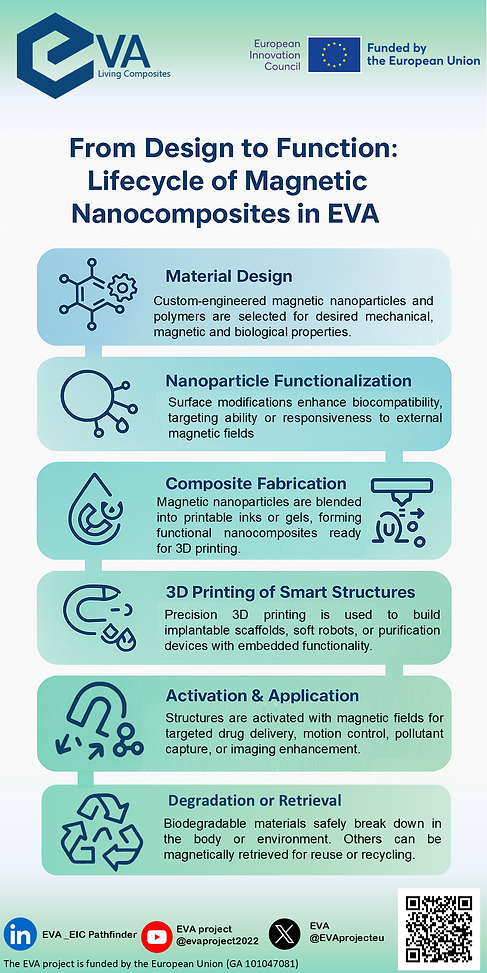
From Design to Function: The Lifecycle of Magnetic Nanocomposites in EVA
The EVA project pioneers a full-spectrum approach to the development and application of magnetic nanocomposites—engineered materials that bring together precision design, functionality, and sustainability.
At the core of our work is a carefully structured process:
-
Material Design
We begin by selecting and engineering magnetic nanoparticles and polymer matrices to achieve the desired mechanical strength, magnetic responsiveness, and biocompatibility. -
Nanoparticle Functionalization
Surface modifications enhance the nanoparticles’ ability to interact with biological systems, improve targeting precision, and respond to magnetic fields for controlled behavior. -
Composite Fabrication
These tailored nanoparticles are integrated into printable formulations—gels or inks—creating functional nanocomposites ready for advanced manufacturing. -
3D Printing of Smart Structures
Using precision additive manufacturing, we create complex architectures such as implantable scaffolds, soft robotic components, or filtration systems with embedded magnetic functionality. -
Activation & Application
Once deployed, the structures are activated using external magnetic fields to deliver targeted therapies, guide motion, enhance imaging, or capture environmental pollutants. -
Degradation or Retrieval
Finally, sustainability is built into the design: EVA materials are either biodegradable within the body or environment, or they can be magnetically retrieved for reuse or safe disposal.
This lifecycle reflects EVA’s mission: to merge advanced nanomaterials, smart manufacturing, and functional design into a single, coherent innovation pipeline that supports next-generation biomedical and environmental technologies.

Benefits of Combining Magnetic Nanoparticles and 3D Printing
At EVA, we’re exploring how advanced materials and fabrication methods can revolutionize medicine and environmental sustainability.
Our latest infographic illustrates the powerful synergies between magnetic nanoparticles (MNPs) and 3D printing—a combination that offers unprecedented precision, control, and functionality across diverse fields.
The infographic highlights soma key benefits of this innovative fusion.
Whether you're a researcher, innovator, or policymaker, this is a quick and visually engaging overview of what's possible when nano meets additive manufacturing.
Spotlight on Collaboration and Innovation: Young Researchers at Work in the EVA Project
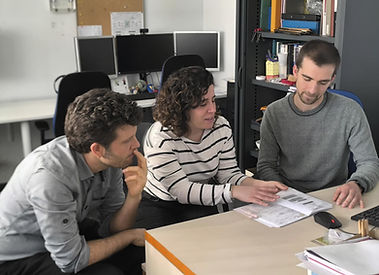
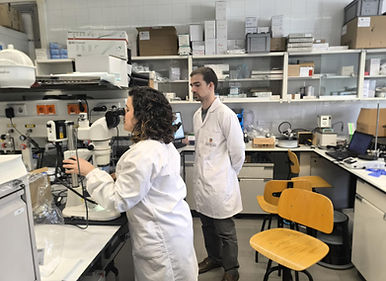
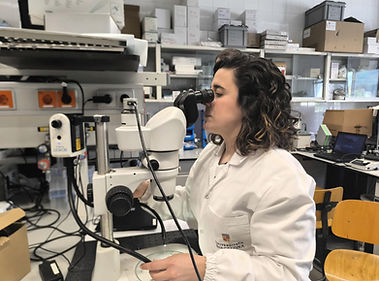
As the EVA project moves closer to its integration phase, collaboration across disciplines and teams becomes more essential than ever. This week, our researchers gathered in the lab and office spaces to push forward the development of the EVA technology.
From microscope work and system testing to intense discussions and planning sessions, the atmosphere was filled with energy, curiosity, and determination—especially among our early-career researchers, who are at the heart of EVA’s progress.
These hands-on moments are a testament to the strength of the EVA consortium: combining expertise, creativity, and teamwork to deliver innovative solutions for the project's mission.
We are proud of the dedication shown by all partners and look forward to the next stages of integration and testing.
Exploring Multi-Material 3D Printing in EVA
The EVA project continues to advance the development of 3D-printing approaches for the fabrication of functional multi-material structures.
The samples shown here provide examples of 3D-printed, multi-material composite structures incorporating functional nanomaterials, demonstrating the versatility of the printing approaches investigated within the project. Different geometries and structural designs can be produced, ranging from relatively simple shapes to more complex three-dimensional architectures.
Developing the ability to combine different materials within a single printed structure is an important step towards creating advanced functional components with tailored properties and behaviours. By controlling material composition together with the geometry and architecture of the printed object, multi-material 3D printing offers considerable flexibility for the design of structures adapted to different technological requirements.
Within EVA, this work contributes to the broader objective of advancing functional materials and additive manufacturing technologies and exploring their potential for future applications across different fields.

EVA at IEEE 3M-NANO 2025 in China

EVA Project Coordinator Josep Puigmartí-Luis delivers keynote lecture at IEEE 3M-NANO 2025
Prof. Josep Puigmartí-Luis, EVA Project Coordinator from the University of Barcelona, participated as a Keynote Speaker at the International Conference on Manipulation, Manufacturing and Measurement on the Nanoscale (IEEE 3M-NANO 2025), held from 28 July to 1 August 2025 in Changchun, China.
His keynote presentation, “How Can Microfluidic Tools Help during the Self-Assembly and Engineering of Supramolecular Systems and Crystals?”, focused on the use of microfluidic technologies for controlling material formation and engineering complex functional systems.
The conference brought together researchers working across nanoscale manipulation, manufacturing, materials and emerging technologies, providing an important setting for scientific exchange and networking. Prof. Puigmartí-Luis's participation offered an opportunity to connect EVA with relevant international research communities, discuss developments in advanced materials and manufacturing, and explore potential opportunities for collaboration. The meeting therefore contributed to the broader dissemination and visibility of the EVA project and its multidisciplinary research activities.

EVA Consortium Meets to Advance System Integration
On June 5th, the EVA project consortium held a focused meeting dedicated to a critical milestone: the integration of all technological components into the EVA system.
As the project progresses toward its final stages, this meeting was key in aligning the technical teams on how to bring together the individual modules and functionalities developed across the various work packages. The goal is to create a cohesive and operational EVA technology platform that meets the project's ambitious objectives.
The discussion covered integration strategies, technical challenges, and timelines, laying the groundwork for a smooth transition into system-level development and validation.
This collaborative exchange was another strong step forward in turning the EVA concept into a unified, functional solution for its intended end users.
EVA at the 247th ECS Meeting in Montréal
EVA Project Coordinator Josep Puigmartí-Luis presents microfluidic approaches for the engineering of advanced materials at the 247th ECS Meeting
EVA Project Coordinator Prof. Josep Puigmartí-Luis from the University of Barcelona participated in the 247th ECS Meeting, held from 18 to 22 May 2025 in Montréal, Canada.
Invited as a speaker, Prof. Puigmartí-Luis delivered an oral presentation entitled “How Can Microfluidic Tools Help during the Self-Assembly and Engineering of Supramolecular Systems and Crystals?” The presentation explored the potential of microfluidic technologies to control self-assembly processes and support the engineering of complex supramolecular systems and crystalline materials.
The event provided an opportunity to engage with international scientific communities working in advanced materials and related technologies, exchange knowledge on state-of-the-art developments and explore potential avenues for future collaboration. His participation also contributed to increasing the visibility of EVA and its research on advanced functional materials and innovative manufacturing approaches within the wider scientific community.

EVA Project Holds Successful 2nd Review Meeting
On April 29th, the EVA project held its second review meeting, bringing together consortium members and expert reviewers appointed by the European Commission, the project’s funding body.
The meeting served as a key milestone in the project's timeline, coinciding with the conclusion of Work Package 3 and the launch of Work Package 4. Project progress and technical achievements were presented and discussed in detail.
The reviewers expressed strong satisfaction with the advancements made so far and provided valuable guidance on how to approach the final stages of the project. Their positive feedback reaffirmed the project's direction and impact.
Beyond the formal review, the meeting was also an excellent opportunity for the consortium partners to connect in person, align on upcoming activities, and collaboratively plan the next steps toward a successful project completion.
Meet the Team - James Nicholas from UoB
James Nicholas is a doctoral researcher contributing to the EVA Project through his work at the University of Barcelona's ChemInFlow group. He is pursuing his PhD under the co-supervision of Prof. Josep Puigmartí-Luis, Dr. Alessandro Sorrenti, and Prof. Andrew deMello, focusing on the development of functional materials via microfluidic techniques.
Within the EVA Project, which brings together interdisciplinary expertise to address challenges in biotechnology, wastewater treatment, robotics, and data storage, James's contributions in supramolecular chemistry and microfluidics play a significant role in advancing the project's objectives
Meet the Team - The Coordinator of EVA
Prof. Dr. Josep Puigmartí-Luis serves as the Coordinator of the EVA project, an EU-funded initiative focused on developing magnetoelectric 3D printing technology to create wirelessly controllable composite materials. In this role, he oversees the project's scientific and strategic direction, collaborating with a multidisciplinary team to advance applications in fields such as biotechnology, robotics, and environmental remediation.
Additionally, Prof. Puigmartí-Luis is an ICREA Research Professor at the University of Barcelona and leads the ChemInFlow group, which specializes in microfluidic technologies, flow chemistry, and materials engineering . His expertise in controlling self-assembly processes at the micro and nanoscale is instrumental in achieving the EVA project's objectives


Innovators' Training on Intellectual Properties
On April 10, 2025, Project EVA conducted a webinar titled "Intellectual Property (IP): The Value, the Protection, the Challenges," featuring Ms. Faye Orfanou, Tech Transfer Specialist, Lawyer, and Managing Partner of Science to Business, as the presenter. The session offered participants a comprehensive examination of various forms of Intellectual Property Rights (IPRs) and their significance in fostering economic value for innovators. Ms. Orfanou delved into the processes involved in establishing, managing, and protecting IPRs, addressed prevalent misconceptions, and underscored the critical importance of strategic planning in effective IP management.
The interactive nature of the webinar fostered engaging discussions, with attendees posing several questions on topics such as the definition and types of intellectual property, distinctions between IP and non-IP assets, and specifics of copyrights. Further dialogue delved into managing IP within EU-funded projects, assessing potential IP assets, IP pre-assessment of technologies and methods, partner IP contributions, and considerations regarding resources and costs. This collaborative exchange underscored the importance of effective IP management in research and development endeavors.
Meet The Team - David Sargent from MBX
The EVA project empowers members of the high-tech SMEs as well as the early-career researchers in the consortium participating in the project to take the lead in translating EVA’s research into innovations.
In our new video, meet David Sargent, the CEO of Magnebotix. Magnebotix, established in 2014, specializes in developing and producing magnetic field generators (MFGs). These systems are capable of generating a wide variety of static or time-varying magnetic fields for research on magnetic field-dependent phenomena. In the EVA project, contributing to the development of magnetoelectric 3D printing technology.

EVA Project Newsletter – Issue 3: Pioneering the Future of Smart Composites
In this edition, we delve into the EVA project's latest strides in magnetoelectric 3D printing technology. Highlights include the integration of electromagnetic systems for voxel-level precision, advancements in multi-material magnetic structures, and insights from the IEEE Advances in Magnetics Conference. Discover how EVA's innovations are set to transform applications in biotechnology, wastewater treatment, and beyond.
Additionally, meet the brilliant minds driving these innovations. In our 'Meet the Team' segment, we feature our Innovators and their role in the EVA project.
Stay informed about upcoming events, such as our exclusive webinar on Intellectual Property Rights (IPRs) scheduled for April 10, 2025. This session will provide valuable insights into establishing, managing, and protecting IPRs in R&D projects.
Don't miss out on these exciting developments and opportunities. Read the full newsletter to explore how EVA is shaping the future of smart composites.
Meet The Team - Stratasys
Stratasys, a leader in 3D printing technology, is one of the SMEs invloved in the EVA project, aiming to develop new 3D printing technology capable of programming the mechanical, magnetic, and electrical properties of printed structures.
Through their expertise, Stratasys contributes to the EVA project's goal of transforming passive composites into active mechanisms, potentially impacting fields such as biotechnology, wastewater treatment, robotics, security, and data storage technologies.
In our new video, meet
Lior Zonder: Materials R&D Manager specializing in photopolymers, with expertise in polymer physics, rheology, nanocomposites, and photopolymers,
Yiftach Katzir: Print Head Technical Lead, focusing on research and development of new printing technologies and implementation of novel resin formulations, and
Shoval Silbert: Technical Manager of the Print Quality team, responsible for developing the print process with a focus on photopolymers
Upcoming Webinar on Intellectual Properties
📅 Date: April 10, 2025
⏰ Time: 12:00 CET
📍 Online
We are pleased to announce an exclusive webinar for our Innovators and all the consortium members, focusing on Intellectual Property Rights (IPRs) and their role in R&D projects.
During this session, our expert speaker will:
✅ Explain how IPRs are established, managed, and protected.
✅ Clarify common misconceptions about IPRs.
✅ Highlight key strategic planning considerations for effective IP management.
This webinar is designed to equip our consortium members with valuable insights into leveraging IP for innovation and impact.

Meet The Team - Ishika Paul from MBX
The EVA project empowers early-career researchers in the consortium as well as the members of the high-tech SMEs participating in the project to take the lead in translating EVA’s research into innovations.
In this video, meet Ishika Paul, a Robotics Engineer at Magnebotix AG that works on designing and incorporating the electromagnetic system to the 3D printer for the EVA project.
Consortium Meeting on WP5 - Exploitation, Data Management and Intellectual Properties
On February 27th, a meeting was held within the framework of the EVA project, specifically focusing on Work Package 5 (WP5), which pertains to the exploitation of project results, data management, and intellectual property.
During the meeting, the discussion centered on identifying and analyzing the exploitable assets derived from the technology developed within the project. Participants evaluated the potential applications of these assets, their commercial and research value, and strategies for their effective utilization. Furthermore, key aspects related to data management and intellectual property rights were addressed to ensure compliance with best practices and regulatory frameworks.
Additionally, the meeting served as a platform to define future actions aimed at maximizing the impact of the project outcomes. These actions include refining exploitation strategies, outlining pathways for technology transfer, and establishing guidelines for intellectual property protection and data governance.
The discussions and insights from this meeting will contribute to the development of a structured approach to ensure the sustainability and broader dissemination of the project’s innovations.


Representation of the EVA project in the 2025 IEEE Advances in Magnetics Conference
Bressanone, Italy, February 9-12, 2025


On 9-12 February 2025 Dr. Semih Sevim from ETH Zurich, represented the EVA project on the 2025 IEEE Conference on Advances in Magnetics at the Forum of Bressanone, Italy as an invited speaker.
In his talk, he presented several approaches for effectively fabricating and delivering small-scale magnetic robots. The strategies involved the magnetically navigated tethered robotic tools to assist in delivering untethered magnetic devices to target sites, a method that offers a promising solution for the controlled deployment of untethered magnetic devices within the complex circulatory systems of the human body.
Moreover, he introduced novel fabrication techniques for creating highly integrated small-scale soft devices that closely mimic the complex motion and morphing behaviors of living organisms. By leveraging microfluidic control to regulate reaction-diffusion processes, he showcased the fabrication of multifunctional and compartmentalized magnetic soft continuum robots (mSCRs). Under controlled RD conditions, these mSCRs can be tailored in terms of geometry, stiffness, and magnetic responsiveness. Additionally, chemically cleavable regions within the mSCRs enable disassembly into smaller robotic units or roll-up structures when exposed to a rotating magnetic field, after being deployed with the aid of tethered magnetic devices.
The presented findings highlighted the importance of new deployment methods and versatile fabrication techniques in the development of highly integrated small-scale magnetic devices, bringing these technologies closer to real-world biomedical applications.

3D Printing in Medicine – A Game Changer for Healthcare
3D printing is revolutionizing the medical field, offering personalized and innovative solutions that were once unimaginable. From surgical planning models to bioprinted tissues, this technology is reshaping patient care, making treatments more precise and accessible.
The process starts with a digital CAD model, which is then printed layer by layer using specialized materials or bioinks. The printer follows precise instructions, creating detailed and functional medical structures.
Bioprinting takes 3D printing a step further by using hydrogels, biomaterials, and living cells to create tissues that mimic real biological structures. This breakthrough supports cell growth and regenerative medicine, opening new possibilities for organ transplants and disease research.
With advancements in the current technology, 3D printing is making healthcare more efficient, affordable, and personalized. This shift is transforming medicine from a one-size-fits-all approach to patient-specific treatments.
3D printing isn’t just the future—it’s already here, changing lives one layer at a time!
Visit our community in Zenodo:
Consortium Meeting on WP3 - Develop and integrate 3D printing and electromagnetic system for voxel-by-voxel manipulation
On January 30, 2025, the Consortium convened a meeting to deliberate extensively on the design and operational parameters of the electromagnetic system. During the meeting, the Consortium reviewed several experimental designs that had previously been tested. Detailed analyses of the results from these experiments were presented, with each design being evaluated based on its performance metrics and potential for integration into the final system. The discussion was aimed at identifying the optimal configuration that would meet the project’s stringent performance criteria.
In addition to the examination of the electromagnetic system’s architecture, considerable attention was given to the properties of the inks designated for use. The Consortium assessed various chemical and physical characteristics of the inks—such as viscosity, conductivity, and thermal stability—to determine their impact on the system’s overall performance. The interplay between the ink properties and the electromagnetic forces was scrutinized to ensure that the system could operate efficiently under a range of conditions.
Furthermore, the meeting focused on establishing the precise conditions required for the magnetic system to achieve peak efficiency. This included a thorough discussion on the necessary calibration of the electromagnetic components and the environmental parameters that could affect system performance. The members considered potential trade-offs between operational robustness and efficiency, emphasizing the need for a balanced approach that would allow for both high performance and reliable operation.
The meeting concluded with the formulation of a detailed roadmap for future research and development. This roadmap outlines a series of follow-up experiments and further design modifications intended to refine the system’s performance. The Consortium agreed on a schedule for subsequent meetings to monitor progress, address any emerging challenges, and ensure that all components of the electromagnetic system and associated ink delivery mechanisms function synergistically to their full potential.


Advancing Innovation: The EVA project showcases the Transformative Power of Magnetics at the MRS Fall Meeting 2024


The Materials Research Society (MRS) Fall Meeting and Exhibit 2024, held from December 1–6, 2024, in Boston, Massachusetts, USA, is the world’s premier international scientific conference dedicated to materials research. This prestigious event serves as a global platform for scientists, engineers, and industry leaders to present and discuss cutting-edge interdisciplinary research spanning both fundamental science and applied technologies.
At this year’s meeting, MagnebotiX, from the EVA project, had the privilege of showcasing the transformative impact of magnetics across various sectors, including medicine, manufacturing, and beyond, representing the ANGIE project. David Sargent presented latest advancements and demonstrated how magnetic-based technologies are driving efficiency, enhancing precision, and opening new frontiers in innovation. From pioneering medical applications to novel industrial solutions, our contributions highlighted the far-reaching potential of magnetic systems in shaping the future of technology.
Second EVA Newsletter
Our second newsletter is now out and delivered!
In this issue you will find details of the project's progress as well as material produced within our project to download.
Download the full version of our Newsletter by clicking the following link:

Empowering Young Innovators (10/09/2024)
The 2nd Innovators Workshop, titled Empowering Young Innovators, was held on September 10, 2024, and led by Dr. Maria Vliora, an Early Career Researcher (ECR) from DF. The workshop took place as part of the PhD course on Precision Medicine at the Department of Molecular and Translational Medicine, University of Brescia, Italy.
It was structured into two key sessions. In the first session, Dr. Vliora discussed career opportunities in industry for PhD graduates, focusing on entrepreneurship and the essential considerations for those looking to establish their own spin-off companies post-PhD. The second session concentrated on strategies for securing funding to support future research and career development. This included guidance on writing successful research proposals and identifying various funding sources available to early career researchers.


2nd Young Innovators Event Announcement (10/09/2024)
In collaboration with University of Brescia, Italy Discovery foundation will organize an online event for Young researchers that want to advance their carrer after their PhD. Dr. Maria Vliora will introduce the EVA project as an example for opportunities for young scientists and how they can acelerate their carreers. She will also speak about funding schemes in Europe and how to aproach European calls.
The event will take place online on the 10th of September 2024, in the frame of the Precision Medicine PhD course that is supported by the Department of Molecular and Translational Medicine of University of Brescia.
Nozzle Team Meeting (20/06/2024)
The current primary focus of The Nozzle Team is on the engineering and optimal operation of the nozzle, as outlined in Work Package 2 (WP 2).
In this meeting, the team delved into the ink mixing system integrated within the nozzle. New theoretical calculations were conducted, addressing questions raised by researchers in the previous session. These calculations focused on the nozzle's design parameters, the pressure applied, and the volumes of ink required to ensure proper operation and effective mixing.
Additionally, the nozzle experiments have been repeated, substituting water-based inks with inks containing higher density solvents. This adjustment aims to observe and analyze the different behaviors exhibited by the inks and to understand how varying densities impact the ink switching mechanism within the nozzle. These experiments are crucial for optimizing the nozzle's performance and ensuring it can handle diverse ink formulations effectively


Tuan Ngo, PhDc from the UoB group visited the ETH group to engage in a collaborative effort, discuss experimental methodologies, and gain a comprehensive understanding of the advanced laboratory techniques employed by the ETH group. His visit took place from 02 to 14 June 2024.
The visit facilitated an exchange of knowledge and expertise, fostering a deeper collaborative relationship and enhancing the career opportunities of the Innovators of the EVA consortium. The researcher aimed to enhance his proficiency in the specific laboratory practices utilized by the ETH group, thereby contributing to the advancement of his own and the UoB group research initiatives.
Collaborative Research Visit and Knowledge Exchange Between the Consortium


School Outreach in Collaboration with Magnet Project
Dr. Maria Guix and Dr. Beltzane Garcia-Cirera, from the University of Barcelona (UoB), have collaborated on the Magnet project, an initiative designed to foster educational alliances that promote academic success and bring science closer to younger audiences. Their contribution to the project took place in May 2024 and focused on engaging second-grade primary school students at Madorell’s School in Molins de Rei, Barcelona.
As part of the outreach activities, the researchers conducted a series of interactive experiments aimed at sparking interest in scientific topics. These experiments included demonstrations related to nanorobots, environmental pollution, and the water cycle, providing students with hands-on learning experiences.
12th World Biomaterials Congress (WBC 2024)
During the 12th World Biomaterials Congress (WBC 2024), Prof. Josep Puigmartí-Luis had the opportunity to visit the Daegu Gyeongbuk Institute of Science & Technology (DGIST). During his visit, he delivered an insightful talk titled "Revolutionizing Materials Engineering and Processing with Microfluidic Tools."
Prof. Puigmartí-Luis was invited by Prof. Hongsoo Choi from DGIST to present his work on May 28, 2024. His presentation focused on the transformative potential of microfluidic tools in advancing materials engineering and processing techniques. The talk highlighted innovative methodologies and applications that could significantly impact the field, sparking interest and discussion among attendees.


Visit of the EVA project coordinator to Beijing Institute of Technology.
Recently, the project coordinator, Prof. Josep Puigmartí-Luis, received an invitation from Prof. Mu-Hua Huang to serve as a Visiting Professor at the Beijing Institute of Technology (BIT). During his visit, Prof. Puigmartí-Luis delivered a lecture on the EVA project, sharing insights and advancements with the academic community at BIT.
In addition to his lecture, Prof. Puigmartí-Luis had the opportunity to tour the state-of-the-art microfabrication facilities at BIT. This visit facilitated discussions with members of various faculties, exploring potential avenues for future collaborations within the scope of the EVA project. These interactions aimed to foster interdisciplinary partnerships and innovative research initiatives, leveraging the combined expertise of both institutions to advance the goals of the EVA project.


Prof. Josep Puigmartí-Luis also had the opportunity to meet with Prof. Xiang-Zhong Chen and his research group from Fudan University, Shanghai, China. During their discussions, they delved into recent advances in the field of Material Science. This meeting provided a platform for exchanging cutting-edge research findings and exploring innovative approaches in materials engineering. The collaborative dialogue underscored the potential for future joint research efforts, aiming to push the boundaries of Material Science and contribute to significant scientific breakthroughs.


Prof. Josep Puigmartí-Luis also visited the laboratory of Prof. Zhen-Zhen Li, where he engaged with his research group specializing in microfluidic technologies. During this visit, he gained insights into their pioneering research and experimental methodologies in the microfluidics domain. The interaction facilitated a detailed exchange of knowledge and ideas, highlighting the latest innovations and potential applications of microfluidic technologies. This visit further strengthened the foundation for potential collaborative projects and interdisciplinary research between their respective teams.


Project outreach within Nanoinventum initiative
Dr. Maria Guix and Dr. Beltzane Garcia-Cirera, from the University of Barcelona (UoB), led the EVA project’s participation in the Nanoinventum initiative (https://ca.nanoinventum.com/) in April 2024 (Figure 3). Nanoinventum is a program aimed at integrating science and nanotechnology into primary education. By developing a tailored course for schools, the project enables young students to familiarize themselves with scientific terminology and ignite their passion for nanotechnology. The primary goal of the EVA ECRs was to educate and inspire young children about nanomaterials and nanorobots by presenting the EVA project’s objectives in simple, accessible language. The participating students, third graders from Sagrada Familia School in Barcelona, engaged in designing nanorobots aimed at addressing health issues affecting society. This effort sought to spark interest in future innovation within the field of nanoscience.


The EVA project in MSc course for Environmental Health
In January 2024, the EVA project was presented in the MSc course of Environmental Health in the University of Thessaly. Dr. Maria Vliora presented details of the project throughout the lesson for "Food and water safety - biotechnological approaches for hygene management" where she discussed the developing technology and envisioned proof-of-concepts for wastewater treatments.
The presentaton of the project raised questions from the MSc students and created very positive impressions as a concept for the removal of micropollutants in wastewaters.
INK Team meeting
The meetings of our EVA INK team are on. In our last meeting, the team reviewed the progress made on Work Package 2, titled "Micro-engineered Nozzles for Printing Multi-Material Magnetic 3D Structures."
Based on the current advancements, several further actions have been planned to ensure the successful continuation of this work package. Key tasks will focus on refining the design and fabrication of the micro-engineered nozzles, optimizing the printing parameters for multi-material integration, and enhancing the magnetic properties of the 3D printed structures. Additionally, the team will conduct comprehensive testing and analysis to validate the performance and functionality of the printed structures, aiming to achieve higher precision and efficiency in the printing process.


EIC Tech2Market Innovation Discovery Trainning Program
Members from the EVA project consortium attended The EIC T2M program that supports researchers in their transition from lab to market by offering free training and support by experienced mentors, experts investors and market representatives.
In the first session on 12th February 2024, the seminar focused on accelerating ideas, creating a start-up to be able to market products, finding investors, pitching techniques and much more.
The next session, on February 16th, 2024, a live trainning session took place where the participants presented their bussiness plans and had the chance to discuss with experts on how to improve pitching techniques and to approach investors.
INK Team meeting on 15th February 2024.
The team discussed advancements on the work being conducted within Work Package 2, "Micro-engineered nozzles for printing multi material magnetic 3D structures".
Further actions on this work package have been planned according to the current progress.


In our 1st Innovators Workshop, held on 25th January 2024, The Opportunities for funding in Europe were discussed.
Prof. Andreas Flouris, from FAME Lab, University of Thessaly was the key speaker and after his talk the discussion was raised regarding the topics that were touched upon.
The young researchers of the consortium had the chance to discuss how to develop their own proposals, how to seek for funding from the European Commission, how to create strong consortiums. All these information aim to empower them and train them for the next steps in their careers.
The 1st Innovators Workshop is here!
The EVA project is organizing a series of workshops aiming to empower the early career researchers and the participants from SMEs in the consortium.
In this 1st Workshop, Prof Andreas Flouris from University of Thessaly will be the guest speaker and will talk about Funding opportunities in Europe and how someone should seek for these as a next step in their career.


1st Review Meeting for the EVA Project
On Thursday 16th November, 2023, the 1st review meeting for the EVA project took place online whith the attendance of the Project Officer, the external expert evaluators, and all the team members of the Consortium.
During the meeting, the progress of the work conducted during the first year of the project was presented to the experts and all questions and considerations were discussed to ensure the project will continue to produce revolutionary technological advancements in the field of 3D printing.
Update Meeting on the EVA Project progress
On Thursday 20th July, 2023, a meeting with all the consortium partners was held online to discuss the progress of our project EVA: Magnetoelectric 3D printing technology – the rEVolution of Actuatable composites.
The partners of the project were informed in the advancements on the 3D printing methods that are being developed within the project and the progress on the use of the novel 3D printing materials.


Ink Team - Update and Progress
On Thursday 20th February 2023, the INK Team held an online meeting to discuss the progress on the research part of the EVA project regarding the synthesis and optimization of the magneto-electric particles and inks that will be used for 3D printing.
Ink Team - Planning of Actions
In this first meeting of the Ink Team the plan was presented on Tuesday 22nd November 2022.
This included the development of the strategy to followed for the characterization of the particle composition and properties that will be used for the ink


Kick off Meeting of the EVA Project
On Thursday 6th October 2022, we held the Kick-off meeting for the European project EVA: Magnetoelectric 3D printing technology – the rEVolution of Actuatable composites.
The goal of the project is to develop new technologies which will allow for precise positioning and orientation of magnetoelectric particles during the 3D printing of multi-materials, enabling generation of multifunctional actuatable composites.


